There are two sets of photos on Flickr which show views of Chortitza. Although they were all taken in 2006, they capture the feeling of a much earlier time. If the pictures are not full screen, click on the arrows in the lower right hand corner to enlarge the picture to full screen. If no description of each photo is visible, click on "show info" on the top, right of the menu bar of the full screen version to bring up the description box.
Photos taken by Erwin Firesen, 2006, Chortitza Colony including several of Neuosterwick.
Photos taken by Dariva, 2006, Mennonite Sites in Ukraine, including several of Chortitza.
Press "Esc" to reduce full screen size.
The Extended Batke Family with Link neighbors
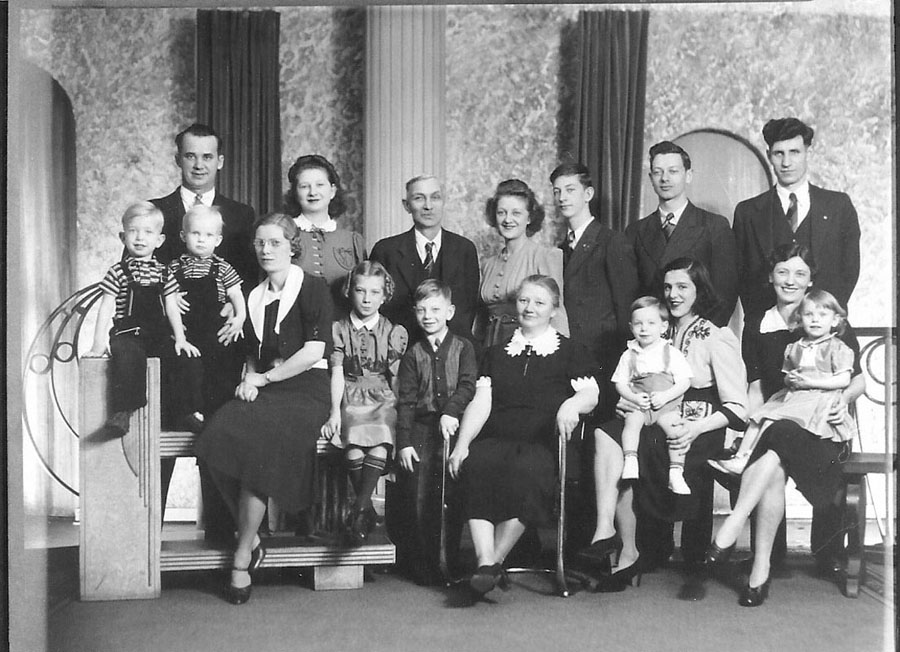
Pictured in the photo: (Back row, standing, left to right) Herman Fredrick, Anna Batke, Henry Batke, Sr., Selma Batke, Henry Robert Batke, William Batke and Arthur Engler. (Front row/sitting, left to right) Donald Fredrick, Robert Fredrick, Katherine Batke Fredrick, Ruth Batke, Edwin Batke, Katherine Reck Batke, Jerald Batke, Edna Kwiatkowski Batke, Mary Batke Engler and Elaine Engler. Taken c1940, possibly to celebrate Henry and Katherine’s 30th wedding anniversary, October 22, 1940. Photo courtesy: Don Fredrick.
Saturday, March 27, 2010

The parents of Catharine Reck Batke

Best of all, she lists her father as John Reck (you can see the correction from Rek to Reck) and her mother as Renata Shirk.
An email note received from Don Fredrick, grandson of Catherine Reck Batke, shared the following information on March 11, 2011 to Elaine Beaudoin:
In a note recently discovered from a visit to my grandmother Catherine Batke, wife of Henry Batke, by the Don Fredrick family before she died and while she was in the nursing home, we find that Renata Scherk, Shierk, Shirk was mentioned by her as the wife of her father John Reck. We assumed at the time of the visit that John and Renata, according to Catherine, did not leave Germany to come to Canada or the US. We wrote down on our note at the time that the spelling was Scherk, not Shirk. Are you sure about the spelling of Renata "Shirk"?
Until more proof is provided, all the spellings -- Scherk, Shierk and Shirk -- should be researched. Thanks Don for the note.

Wednesday, March 24, 2010
Grosse Île, Canada video
Although this video is intended to honor the Irish who died at Grosse Île, Canada when emigrating to North America, it gives a glimpse of what the Batkes might have seen when the ship Pallanza arrived on September 28, 1912.
Port of Quebec, Grosse Île
The Batkes entered the Port of Québec on July 28, 1912. The receiving station for the Port of Québec was Grosse Île at the time. An excerpt about Grosse Île follows:
"The quarantine station on Grosse Île, an island located in the middle of the St. Lawrence river, 48 km downstream from Québec, was established by colonial authorities in 1832, in response to reports that new immigrants had various contagious diseases. With cholera outbreaks in 1832 and 1834, and a deadly typhus epidemic in 1847-1848, thousands of new immigrants were quarantined on the island, with thousands eventually perishing. The victims of the latter epidemic were mainly Irish immigrants fleeing the potato famine. This period of virulent epidemics came to an end only after another outbreak of cholera in 1854.
"At the time of Confederation in 1867, the Canadian government formulated a comprehensive policy on immigration and settlement, requiring the establishment of a reliable, efficient quarantine station. Dr. Frederick Montizambert was in charge of establishing modern facilities at the Grosse Île quarantine station, where he acted as medical superintendent from 1869 to 1899. As fewer people immigrated to Canada as a result of the First World War (1914-1918) and the Great Depression (1930s), and knowledge of microbiology and the treatment of contagious diseases was advanced, the hospital on Grosse Île was reduced to treating minor childhood infections such as diphtheria, chicken pox and measles. New international health agreements stated that people infected with these diseases no longer had to be quarantined and serious infections such as cholera, typhus and smallpox could be successfully treated at the Parc Savard Hospital in Quebec, founded in 1907. The quarantine station on Grosse Île was closed in 1937."
Quarantine And Public Health: The Changing Role of Grosse Île, by André Sévigny, Historian, September 1995.
"The quarantine station on Grosse Île, an island located in the middle of the St. Lawrence river, 48 km downstream from Québec, was established by colonial authorities in 1832, in response to reports that new immigrants had various contagious diseases. With cholera outbreaks in 1832 and 1834, and a deadly typhus epidemic in 1847-1848, thousands of new immigrants were quarantined on the island, with thousands eventually perishing. The victims of the latter epidemic were mainly Irish immigrants fleeing the potato famine. This period of virulent epidemics came to an end only after another outbreak of cholera in 1854.
"At the time of Confederation in 1867, the Canadian government formulated a comprehensive policy on immigration and settlement, requiring the establishment of a reliable, efficient quarantine station. Dr. Frederick Montizambert was in charge of establishing modern facilities at the Grosse Île quarantine station, where he acted as medical superintendent from 1869 to 1899. As fewer people immigrated to Canada as a result of the First World War (1914-1918) and the Great Depression (1930s), and knowledge of microbiology and the treatment of contagious diseases was advanced, the hospital on Grosse Île was reduced to treating minor childhood infections such as diphtheria, chicken pox and measles. New international health agreements stated that people infected with these diseases no longer had to be quarantined and serious infections such as cholera, typhus and smallpox could be successfully treated at the Parc Savard Hospital in Quebec, founded in 1907. The quarantine station on Grosse Île was closed in 1937."
Quarantine And Public Health: The Changing Role of Grosse Île, by André Sévigny, Historian, September 1995.
Pallanza Manifest, 1912

Pallanza Manifest, page 15

Line 27: $580(?) in cash, Batke, Johan, age 35
Line 28: Batke, Anna, age 65
Line 29: Batke, Anna, age 11
The Batkes state they can read and write; their country of birth is Russia and their race is German. Their destination is Ernfold, Saskatchewan. Johan states he was a farmer in Russia and plans to be a farmer in Canada. They say they plan to "always" stay in Canada and declare their religion as Evangelical. They note they will be traveling inland on the Canadian Pacific Railway (CPR).
Tuesday, March 23, 2010
Pallanza Manifest, page 16


Listed on page 16 of the Pallanza manifest for July 13-28, 1912 are several more of the Batke family.
Line 1: $160 in cash; Batke, Heinrich, age 34
Line 2: Batke, Catarina, age 22
Line 3: Batke, Catarina, age 2/12
Line 4: $50 in cash; Batke, Karl, age 29
Line 5: Batke, Frederika, age 24
Line 6: Batke, Anna, age 2
The information for these Batkes is the same as for those on page 15. The adults state they can read and write and plan to stay in Canada permanently. They declare their country of birth as Russia, race as German and their destination as Ernfold, Saskatchewan. The male adults say they were farmers in Russia and that they plan to be farmers in Canada. They also state their religious denomination as Evangelical. And, they plan to travel, once they land, on the Canadian Pacific Railway (CPR).
Subscribe to:
Posts (Atom)