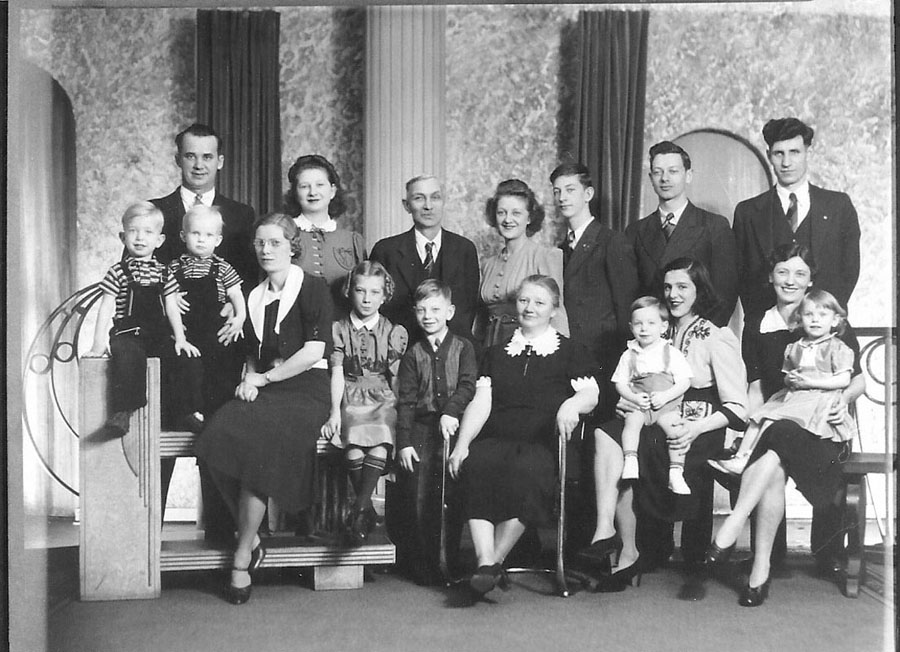
The Extended Batke Family with Link neighbors

The Extended Batke Family with Link neighbors
Pictured in the photo: (Back row, standing, left to right) Herman Fredrick, Anna Batke, Henry Batke, Sr., Selma Batke, Henry Robert Batke, William Batke and Arthur Engler. (Front row/sitting, left to right) Donald Fredrick, Robert Fredrick, Katherine Batke Fredrick, Ruth Batke, Edwin Batke, Katherine Reck Batke, Jerald Batke, Edna Kwiatkowski Batke, Mary Batke Engler and Elaine Engler. Taken c1940, possibly to celebrate Henry and Katherine’s 30th wedding anniversary, October 22, 1940. Photo courtesy: Don Fredrick.

About Henry Batke and Katherine Reck

Heinrich Batke, the son of Martin Batke (c1848-b1912) and Anna Lock (1848-1939) was born in Chortitza, Russia on September 7, 1877. Also in Russia, Catharina Reck was born on October 14, 1890. Her parents were John Reck and Renata Shirk. Henry and Katherine married in Russia on September 22, 1910. On July 13, 1912, Henry, his wife and seven month old daughter, Katherine, sailed from the Port of Bremen, Germany on the ship Pallanza. They traveled to Quebec City, Canada arriving on July 28, 1912. They immediately left on a special Canadian Pacific Railroad train to Saskatchewan, Canada. The Batkes homesteaded in Lydiard, Moose Jaw, Saskatchewan between 1913 and 1918. On October 3, 1917 Henry Batke became a citizen of Canada. Due to England's sovereignty over Canada, he became a British citizen. Finding farming in Canada difficult, on December 7, 1921 the Batke family, now also including Mary, William and Selma, left for Yellow Pine, Alabama. After the birth of Anna and much hardship in Alabama, the family moved to St. Joseph, Michigan where children Henry, Ruth and Edwin were born. Henry, a furniture maker in Russia, became a machine operator at the 1900 Corporation, a fore-runner of Whirlpool, in St. Joseph. After Henry's death on April 7, 1949, Katherine Reck Batke married Gustav Schmeichel in 1959. Katherine Reck Batke Schmeichel died at the Claremont Nursing Home in Benton, Michigan on October 28, 1979.
Showing posts with label Chortitza. Show all posts

Friday, November 12, 2010

The Story of Jacob and Maria Link - Part 1 of 9

Darlene (Dee) Byron Milbocker has put in writing the story of her grandparents, Jacob and Maria Link.  She has graciously permitted its posting on this Blog so the larger Link and Batke families can appreciate the struggle and the strength it took for these immigrant families to make a better life for all of us.  

Don Fredrick, grandson of Henry and Katherine Batke, commented on the history with the following:

“The whole story, as far as it goes, impacts us directly, our generation.  But the effect, perhaps in a lesser way is important for the generation that follows ours.    Origins mean something!  Origins mean a great deal when we realize that our ancestors had to face all of this to migrate to America and what it meant already in the early part of the last century as a result of the kind of culture developed by those already here.  Our kids need to know!!!  Their families need to hear the story that is so importantly told by both of you and now potentially will be repeated on the Batke blog even though there may be some uncertainty about who the characters are in the pictures.  Your history makes these pictures especially meaningful to you and yes, even the Batkes.  Thanks to you Dee and Bonnie.”   Nov. 2, 2010.


THE STORY OF JACOB AND MARIA
Written by Darlene Byron Milbocker
Granddaughter of Jacob and Maria
  
This is the story of Jacob and Maria Link and their escape from Russia in the year 1912, nearly one hundred years ago!  Thanks to the internet and the research done by so many of the family, the story behind the story has been discovered!  Until a short time ago, we were quite unaware, as our grandfather did not offer much about his and grandma’s experiences for his own reasons, and as a result, we did not inquire!    

And so, this story is written with a composite of information from family members who have tried to piece together their grandparent’s life story!  Timothy Link, son of Jacob Link Jr. did interview his Grandfather for a school project, which gave us our first bit of information.  His mother, Pat Link and sister Pam Link Schoonaert, all from S. Bend, Ind., at that time, gathered much information.  Bonnie Link Fago, (an enthusiastic genealogist) daughter of Raymond Link, from La Mesa, California, has searched intensely and has been very successful, as was Brenda Link, wife of Gary Link, from Vernon British Columbia, Can.  Brenda recently passed away on September 9, 2009.  She also was an enthusiastic genealogist and had contributed a great amount of information!  Gary is the grandson of Friedrich Link and Maria Elizabeth Knack and Gary’s father was Jakob  (Jacob, also known as Jack) Link.  Sharon Byron Lampros, granddaughter of Jacob and Maria, interviewed and recorded her mother Frieda Friedrika Link Byron on February 2, 1993.  I, Darlene Byron Milbocker, also daughter of Frieda Link Byron, not a part of gathering information necessarily, was graciously given information by all parties.  Our brother Frank Byron, who studies Russian history as a hobby, was also very helpful.  We three are from Allegan, Michigan.   Just recently, contact has been made with a Canadian cousin, Marvin Mutschler of Medicine Hat. Alberta.  He is the son of Anne Link, Mutschler, and grandson of Friedrich and Maria Link.  Marvin has given us some fascinating information that has been incorporated into our story!

Quite recently, contact was made with grandchildren of the Henry Batke family, and so much was shared by them!  Don Fredrick , son of Katherine Batke Fredrick gave us a wealth of information, and Elaine Engler Bush, Anna Batke Pesko, and Elaine Beaudoin  have contributed greatly.  Their information opened up many new avenues and filled in many gaps.

As you will see, generation after generation used the same names over and over, sometimes changing the spelling, making it very difficult to decide who is who.  It can be assumed that the names were repeated so often, to remember, or possibly  honor those that were never seen again. 

One day, it suddenly occurred to me that I had to put all this information, such as it was at that time, into “story form”, for the sake of my descendants.  So much has become available since, making original versions of the story obsolete.  So once again, I attempt to document their story, with the information we now have.  I have come to realize that this story may never be finished, as more information becomes available and some memories are “jogged,” making for some interesting insights into the lives of our ancestors.


FRIEDRICH AND ELIZABETH LINK

Our story begins with Friedrich Link, born 1852 in Steegan, West Prussia and Elizabeth (Hopp) Link, born in Rosengart, Russia 1854, who became the parents of our Jacob Link.  There were also Elizabeth, Friedrich, and Peter.   Friedrich and his parents may have become part of the migration of Germans to the Ukrainian Republic of Russia.  Most likely, they as others, fled their homeland to avoid the wars of the 19th century in Germany, through Germany and across Germany, by other nations.  (It is here that we find a discrepancy in our story!  I used the information we have from Brenda Link stating that they lived in Russia, but Grandpa Link, in his statement to his Grandson, Tim, said that they lived in Germany).   This is still being unraveled.

The journey to Russia in those days was an ordeal to try the strongest, beyond the endurance of many.  But the German immigrants still came to the Black Sea region by the thousands.

Peter and Jacob Link standing;
Elizabeth and Friedrich Link sitting.
Photo courtesy: Bonnie Fago, date unknown
Friedrich and Elizabeth were married in Russia, city not known.  His father’s name was Johan.  Her father’s name was Gottfried Hopp and her mother’s maiden name was Karoline Whorms.  Nothing more is known.

Friedrich and Elizabeth Link moved to an area above the Black Sea known as Alexandrovsk, Ekaterinoslav.  The city has changed names many times.  It was Yekaterinoslav 1776-1782, re-established 1783-1797.  It was Novorossiysk from 1797-1802, Yekaterinoslav from 1802-1917.  It was Sicheslav from 1917-1918, Yekaterinoslav again from 1918-1926 and became the province of Dnepropetrovsk/Dnipropetrovsk in 1926 to present day.    It is surrounded by Mennonite communities. 

Their sister, Elizabeth Link was born Aug. 30, 1875 in Gerhartstal, Russia,   She married Peter Schultz, who was born August 14, 1875 in Chorititza.  Both Gerhartstal, and Chorititza are Mennonite communities  in Russia.

At one time, similar promises had been made to the Germans of Prussia, and a group known as the Mennonites, by Catherine II, Empress of Russia.  The Mennonites had an important role in the background of the Germans who found themselves in Russia and eventually immigrating to Canada and the United States

Catherine II reigned from 1762 to 1796 as Empress.  Her son Paul I, reigned in Russia  from 1796 to 1801. Nicholas I, son of Paul I, reigned from 1825 to 1855, and Nicholas II,  reigned from 1894 to 1917, as Czars.  Catherine made promises to the Germans who immigrated to Russia.   Nicholas broke them!     

Catherine the Great had been very motivated to put swampland that the royal family owned to productive and profitable use, and was informed how industrious and innovative the Mennonite farmers were.  She encouraged only Mennonites to settle the region of Russia known as Chorititza, a city near the Dnieper River.  The Royal family exploited and profited quite well in this arrangement and helped to transform the region into a “breadbasket” for Russia.  The political climate changed over time however, and allowing these “immigrants” to be important agricultural producers fell out of favor after Catherine II died.  A plan was announced that all special privileges would end by 1880.  Now they were required to give up their culture, language, and deliver their sons to the Russian army.  Because of the changes in the Czar’s policies towards the Germans living in Russia, a large wave of immigration to America began in the late 19th century.  This included the Mennonites.  By 1912, 300,000 Germans had “immigrated from Russia to North and South America

The Dneiper River was an important route traveled by the Mennonite and Lutheran families in establishing the Dnepropetrovsk region, and Chorititza, nearby.  One and one half million Germans moved to Russia and were scattered about in communities above the Black Sea, the Volga, and the Dons Rivers, the Volhynien area and Crimea.  The Germans were all promised that they could:
1.         Keep their own language
2.         Churches
3          Have their own schools
4.         Never have to serve in the military.                                                 

In 1873 a delegation of 12 Mennonites explored North America, seeking large tracts of fertile land.  Canada was chosen, which promised privileges for the Mennonites, previously held in Russia, near Manitoba, Canada, such as:
l.          They could keep their own language.
2.         Freedom of worship
3.         Control of their own schools
4.         Exemption from military service

The Story of Jacob and Maria Link - Part 2 of 9

JACOB’S EARLY YEARS

When Jacob was a schoolboy in Russia, he attended school 39 hours a week for 5 1/2 days a week. He had to read and write the Russian letters, the English letters and the German letters.  Each hour the teachers changed off and taught a different grade. 

Rempel Plant, Chortitiza, Ukranine, Russia.  Photo: c 2006
At the age of 16, he worked in a machine shop in the Ukrainian Republic, which is an industrial center.  He received a certificate of high recommendation from his employer B. W. Remple in 1902, which reads that “Jacob Fredrich Link worked in my plant in the metal-worker’s department in 1902.  He did a good job”.   Signed  B.W. Rempel.  Grandpa was 16 yrs. old.  The Rempel factory developed and manufactured an improved version of the seeder plow, also manufactured cultivators, fanning mills, reapers and underground packers that were used to pack newly planted seed to encourage germination.    

Later he became a furniture maker by trade, possibly working alongside a man who would become his lifelong friend, Mr. Henry Batke, who will become a very important part of our story.

When Timothy Link, grandson of Jacob Link interviewed his grandfather for a school project, he was told that, he (Jacob) was born, lived, and worked in Russia, but left when he was a young man, because the Bolsheviks were taking over the government life in Russia”.  “Life in Russia was changing so much that it wasn’t a happy life anymore and they were no longer free!”    Marvin Mutschler’s information adds more insight into the reason that the Link families left.  He states, “the only thing I remember my mom (Anne) telling me as to why our grandparents fled the old country was that, life was intolerable there and people were starving.”
             
Russia’s defeat in the Russian – Japanese war in 1905 resulted in revolts against the Czar in many places, including Yekateranoslaw (Dnepropetrovsk)!  Tens of people were killed and hundreds wounded.  There was a wave of anti-semantic attacks.

Jacob Link, 1907
Friedrich Link c 1907
Our grandfather and his two brothers were in the Russian Army, and I am told that in the pictures that we have of them, they are wearing officer’s uniforms!  Grandpa served for three years, from the age of 21 to 24 years of age.  I have to surmise that they were part of the Russian draft, (a promise broken)!  Our grandfather was a valet to a Russian General, waiting on him and polishing his boots, at least for a time, but he must have risen in rank, since he did become an officer.  (As told to Bonnie Link Fago by her father Raymond Link.)   I am told that when you were in the Russian Army, you were in it for a long time, (possibly life), and that many officers were being assassinated, and those under the officers were being assassinated also.  Many began to desert.


Peter Link, c 1907

 “Conditions were ripe for revolution as the country was without a real government!  There was no longer a middle class, the aristocracy was ruined and without influence, and there was much corruption!  There were about 100 million people gradually becoming poorer and poorer as they bore all the burden of taxation, and were being drafted into the Army by the thousands.  The revolutionary movement had a profound impact on the Russian character.  Its creed of violence and treachery was poisoning the whole structure of society!”  Quoted from the “Russian Dagger”.

It has always been thought that Grandpa and Grandma Link left Russia for a better life, but after studying Russian history and especially the events that took place in their own area, there can be no doubt that they fled for their lives!!  And just in time, as we will see!


TIME TO FLEE

Jacob Friedrich Link, born March 5, 1886, married Maria (Mary Philips) September 4, 1911, at Alexandrwsk Church, in Ukrainian Republic, Russia.  They were married  by Pastor G. Rath.  She was born May 14, 1895.  Their marriage certificate states Jacob Link, son of the “German citizen”, Friedrich Link, and Maria Phillip, daughter of the “German citizen”,  Ferdinand Phillip, were married, both Lutheran religion!  The distinction of being a “German Citizen” was always with them!

The Story of Jacob and Maria Link - Part 3 of 9


THE CONNECTION

Jacob Link and Henry Batke.
Photo courtesy: Don Fredrick, date unknown
It is here that we see a connection between the Batke family and the Link family and what was to become a lifelong friendship!  The Alexandrwsk Church was also the church where Katherine Batke, daughter of Henry Batke, was baptized  May 20, 1912 by the same Pastor:  Pastor G. Rath. 

In 1992, Frieda Link Byron, in answer to some questions for her niece, Pam Link Schoonaert, said, and her exact words were, “the Links had some neighbors, the Batke family, that traveled with them to Canada from Russia, to St. Joe”.   We now know that they must have become friends through work and church, but they were also neighbors!  “Being neighbors” doesn’t necessarily mean right next door, but reasonably close!  The small villages around Chortitza were populated with both Mennonites and German Russians.
                                                                                   
I envision them quietly, (even secretly) making their plans to leave Russia, sitting around someone’s kitchen table, with the “lamp down low”.  As it turns out there were four groups that planned to leave.  The Batke family, Friedrich and Maria Link and their family, Jacob and Maria Link, and Peter Link, age 24 a single man.  Peter never married.

Since the Batke and the Link families lived in and near Mennonite villages near Chortitza they may have been viewed  as such by the local population.  The Mennonites were being targeted, giving all even more reason to leave.

June 25, 1912
 On June 25, 1912 the Batke family, consisting of Henry Batke, age 34, and his wife Katherine Reck Batke, and their infant daughter Katherine, 7 months old, were issued a travel pass in German and Russian to exit Russia to Germany and “return” by the German Kaiser Embassy.  It is suspected that this pass enabled them to flee Russia through Germany and on to Bremen where they boarded  a ship called the Pallanza on July 13, 1912.   The ship’s manifest also lists Johann 38, Anna 65 (great grandmother Batke), Anna ll, Karl 29, Friedrika 24, and Lena 2.  Total of nine.  They went through customs in Quebec, Canada on July 28, 1912.  There destination was Swift Current, Lydiard, Canada.  They settled on a quarter section of land containing 160 acres. 

One has to assume that the Batke’s, and the Links may have had help from some of the Mennonites who were already settled there, as the end of July arrival does not give much opportunity to find or build shelter.  We can  assume that they all helped each other!  We know that they did build a 16x24 house, an 18x30 barn and a 12x14 grainary.

After August 9, 1912
Maria & Friedrich Link, Canadian prairie, c1913


The next family to leave was the eldest brother of Jacob, Friedrich Link, born Oct. 14, 1876 and his wife Maria Knack Link. Born in Kronstahl, Jekaterinaslav, Russia on Dec. 10, 1877, and their children, Elisabeth Link, born in Kronstahl, Russia, Dec 6, 1900, Fredrick Edward Link, born Feb. 15, 1904, in Kronstahl, Russia., daughter Helena Link, born July 30,1905, Osterwick, Jekaterinoswaw, Russia., son John Link, born Dec. 18, 1907, Kronstahl, Russia, son Jakob (Jack) Link, born Jan 21, 1910, and son Peter Cornelius Link, born Aug. 9, 1912, Kronstahl, Russia.  Since Peter Cornelius Link was their last child born in Russia on the date of Aug. 9, 1912, it was shortly thereafter that the family left.  Total of eight.   They made their way to Rotterdam, Netherlands and sailed on the Noordam, from Holland-America Shipping Line.  Their fare was $380.00 for the family.  Their port of arrival was Halifax, Nova Scotia.   Maria had just given birth to Peter on the 9th of Aug. and their arrival date in Nova Scotia was August 25, 1912!  Destination was Moose Jaw, Canada.   He established a wheat farm there in what would seem to be a very short time.  

A very near tragic accident happened to baby Peter on the ship Noordam,  (remember he was only a few weeks old!)   The baby was lying on the bunk,  when the boot of a sailor man, who was high up on the mast, fell, and landed on the head of baby Peter.  At first they truly believed the baby was dead as a result, and they were preparing to put him overboard, when he was observed to have taken a breath, and they suddenly realized he was still alive!  (As told by Marvin Mutschler.)

When the family arrived in Canada, the children (including baby Peter) somehow became separated from the adults, and Friedrich and Maria had no choice but to get on the train bound for Saskatchewan without their children.  The children had possession of the family pots and pans and nothing else.  Somehow the children made it to Saskatchewan awhile later, and they were all reunited!!   (Also told by Marvin Mutschler.)

November 24, 1912
Maria and Jacob traveled to Canada on the S.S. Rijndam, 1913
Our Jacob and Maria were the next to leave November 24, 1912.  Peter, Grandpa’s younger brother was to travel with them, but mysteriously, his name was crossed off the manifests twice.  They apparently had made their way to Hamburg, Germany and were to board the Prince Oskar, but their names are crossed off the manifest!  Then they make their way to Rotterdam, Netherlands, and his name is crossed off the S.S. Ryndam manifest also!  Grandpa and Grandma did continue on their way arriving in Halifax, Nova Scotia, without Peter! 

Their first child, a little girl they named Maria, was born on ship, but died, and was buried at sea.  They arrived in Halifax, Nova Scotia on January 27, 1913 at 9:35 o’clock.  Tickets were $41.00 for two people.   They then boarded the Canadian Pacific Railroad at 8 A.M. on January 28, 1913.  There destination was Grandpa’s brother Friedrich’s farm, Moose Jaw, Saskatchewan, Canada.  Upon their arrival in Moose Jaw, they would have traveled a third of the way around the world! 

Herein lies a mystery.  Sharon and I both remember our mother saying that baby Maria was buried in the Baltic Sea, which could be, if they traveled to a port on the Baltic, but that would result in them traveling by ship on the Baltic to get to Hamburg, which doesn’t make sense to us, but it may have to them!   Traveling for Grandma would have been easier on water, than over land, but we also know she became very sick at some point!  Pregnant and seasick??  We have never found how they traveled from home before getting on board the boats; by land, by horse and wagon, train, or possibly by boat on the Dneiper River.

From November 1912 to January of 1913 gave Jacob and Maria a nearly two month stay in Germany including travel time to Rotterdam (unclear)!  It is here that our mother told of an incident that happened in Germany.  They needed a place to stay, a man told Grandpa that “he knew of a place.”  He told Grandma to “stay here” while he went with the man to look.  She is alone in a strange country, and she became frightened when he didn’t return, and started to cry.  After a time, he did return and told her that the man had tried to rob him!  These were treacherous times! 

Elaine Engler Bush’s (granddaughter of Henry and Katherine Batke) thoughts on why the grandparents went to Breman and Hamburg first, were that their passes to leave Russia to go to Germany, said that they had to return!  So it is felt that they went to the end of the allowable line and then found their way to Rotterdam, Holland (Netherlands.)  There the Batke’s boarded the Pallanza and the Link’s boarded the Ryndam on l-27-13.  They then sailed for Canadian Ports of Quebec and Halifax.

MARCH 15, 1913
Four months later on March 15, 1913, Peter Link boarded the Barcelona from Breman, Germany with Friedrich, age 26 and Elizabeth Knack, age 25, brother and sister-in-law of Maria Knack Link , (our Jacob’s sister-in-law) along with their infant  Elizabeth, 4 months old, and Catharina Knack, age 18, also sister of Maria Knack Link.  Total of five.  They actually fled Russia earlier than this as it took some time to get across Russia.  They arrived in Portland, Maine on April 3, 1913.  Destination Moose Jaw, Canada.  Home of Friedrich and Maria Knack Link.

I have to ask myself, where was Peter for the four months?  Did he go all the way back?  Did he help escort Grandpa and Grandma because she was pregnant?  Did he go all the way back to help the Knack family get through?  How else would he have met up with the Knack family?  Communication was not what it is today!!

Notice that the four groups left about 3 l/2 to 4 month’s apart, different boats, from different ports, and each arrived in different ports!  There was a reason for all this!  When they did leave, they had to know that more than likely they would never return, leaving parents, grandparents, siblings, extended family, friends, jobs, possessions behind!  For the families with several small children, to pick up and leave for places unknown, took an enormous amount of strength and courage!  The women were traveling soon after having a baby, or while pregnant!  But they were strong Lutherans, people of faith!

It is quite certain that our Jacob, Friedrich, and Peter never saw their parents or sister again.  Why they didn’t leave also, is somewhat of a troubling mystery.  We now know that circumstances were extremely bad there, including starvation, so why didn’t they leave when they had the chance?   Were they not physically able to travel?  I do remember that Grandpa used to send packages to his sister; one would wonder if she ever received them.  Records show that she did immigrate to Germany after her children were born.

Thursday, October 21, 2010

Katherine Reck Batke Schmeichel Obituary, 1979

K. Schmeichel
Mrs. Katherine (Batke) Schmeichel, 89, of Route 2, Box 470, Coloma, died Sunday evening at Claremont Nursing Home, Benton Harbor.

Funeral services will be held Wednesday at 2 p.m. at Kerley and Starks Funeral Home, St. Joseph, where friends may call beginning at 7 p.m. today.  Burial will be in Riverview Cemetery.  Memorials may be made to Trinity Lutheran church of which she was a member.

Mrs. Schmeichel was born October 14, 1890, in Cortiza, Russia.  Survivors include: five daughters -- Mrs. Katherine Fredrick, Mrs. Alex (Anna) Pesko, Mrs. Robert (Ruth) Jonatzke, all of St. Joseph.  Mrs. Arthur (Mary) Engler of Coloma, Mrs. Olin [sic] (Selma) Smith of Seminole, Okla.; three sons -- William and Henry Batke, both of St. Joseph, Edwin Batke of Coloma; 20 grandchildren; 24 great-grandchildren; and one sister, Mrs. Lena Kampes of Hamm, West Germany.

The Herald Palladium, Benton Harbor-St. Joseph, MI, October 29, 1979, p. 10, col. 3

Wednesday, April 14, 2010

Henry Batke, Certificate of Naturalization, 1917

On October 3, 1917, Henry Batke became a British citizen of the Dominion of Canada. It is very likely Henry had to go to Swift Current to collect his Certificate of Naturalization.

There is a curious line in this document:

"This is therefore to certify to all whom it may concern that, under and by virtue of the said Act Henry Batke has become naturalized as a British subject, and is, within Canada, entitled to all political and other rights, powers and privileges and subject to all obligations to which a natural born British subject is entitled or subject within Canada with this qualification, that he shall not when within the limits of the foreign State of which he was a subject previous to the date hereof, be deemed to be a British subject unless he has ceased to be a subject of that State, in pursuance of the laws thereof, or in pursuance of a treaty or convention to that effect."

So, Henry could, theoretically, still be a Russian subject if he returned Russia!  Also, if I read this correctly, he was only a British subject in the Dominion of Canada, not in the other countries which formed Great Britain.

With Henry's naturalization final, he could now complete his patent for his homestead which he began on March 22, 1913.

Henry Batke, Certificate of Naturalization, File #7313, Family History Library, Salt Lake City, Utah, MF#2294910, (October 3,1917); Swift Current Judicial District, Saskatchewan, Canada.

Posted by Picasa

Henry Batke, Oath of Residence/Allegiance, Canada, 1917

Before anyone could become a citizen of Canada, an Oath of Residence was required. The individual had to swear that "in the period of five years preceding this date, I have resided at least three months in the Dominion of Canada, with the intent to settle therein, without having been during such three months a stated resident in any foreign country, So help me God." Henry Batke swore to this on July 18, 1917. (Note in the following post, the Certificate entitling Henry Batke to Naturalization states that he has been in the country for three years.  This is confusing.)

Additionally, an "Oath of Allegiance" was required. The document reads:
"I, Henry Batke, formerly of Thortz in the Province of Jekaterinslaw, Russia, and known there by the name of Henry Batke and now residing at Lydiard, P.C. in the Province of Saskatchewan, farmer, do sincerely promise and swear that I will be faithful and bear true allegiance to His Majesty King George V., as lawful Sovereign of the United Kingdom of Great Britain and Ireland, and of the Dominion of Canada, dependent on and belonging to said Kingdom, and that I will defend him to the utmost of my power against all traitorous conspiracies or attempts whatsoever which shall be made against His Person, Crown and Dignity, and that I will do my utmost endeavour to disclose and make known to His Majesty, His heirs or successors all treason or traitorous conspiracies and attempts which I shall know to be against Him, or any of them; and all this do swear without equivocation, mental evasion or secret reservation. So help me God."
Henry swore this oath before George Mayson, Justice of the Peace, in Chaplin, Saskatchewan on July 18, 1917.

Henry's signature appears twice on this document. Note that "Chortitza" has variant spellings depending on whether the document is in English, German or Russian. "Choritiza" and "Thortz" are the same place.  Also, "P.C." after Lydiard, stands for "Postal Code." 

The Justice of the Peace then drew up another document entitled: "Certificate that Alien is entitled to Certificate of Naturalization." That document follows in the next post.
Posted by Picasa

Saturday, March 27, 2010

Photos of Chortitza, Russia

There are two sets of photos on Flickr which show views of Chortitza.  Although they were all taken in 2006, they capture the feeling of a much earlier time.  If the pictures are not full screen, click on the arrows in the lower right hand corner to enlarge the picture to full screen.  If no description of each photo is visible, click on "show info" on the top, right of the menu bar of the full screen version to bring up the description box.

Photos taken by Erwin Firesen, 2006, Chortitza Colony including several of Neuosterwick.

Photos taken by Dariva, 2006, Mennonite Sites in Ukraine, including several of Chortitza.

Press "Esc" to reduce full screen size.

Tuesday, February 23, 2010

Chortitza, Russia

Henry Batke was born in 1877 in Chortitza, Russia per his Canadian naturalization papers.  Chortitza was a major Mennonite settlement.  Although there is no proof that the Batkes were Mennonite, they lived with the Mennonites in Russia and then later in Saskatchewan, Canada.  Henry's daughter Katherine was born in Pawlowka, Russia, which by 1943 came to be called Osterwick, and can be seen to the south west of Chortitza on this map.  In 1912, Katherine was baptized in the Lutheran Church in Russia before immigrating to Canada with her parents.
Chortitza Mennonite Settlement
(map) in 1943.
Mennonite Encyclopedia,
v. 1, p. 572.
Chortitza Mennonite Settlement, 1943