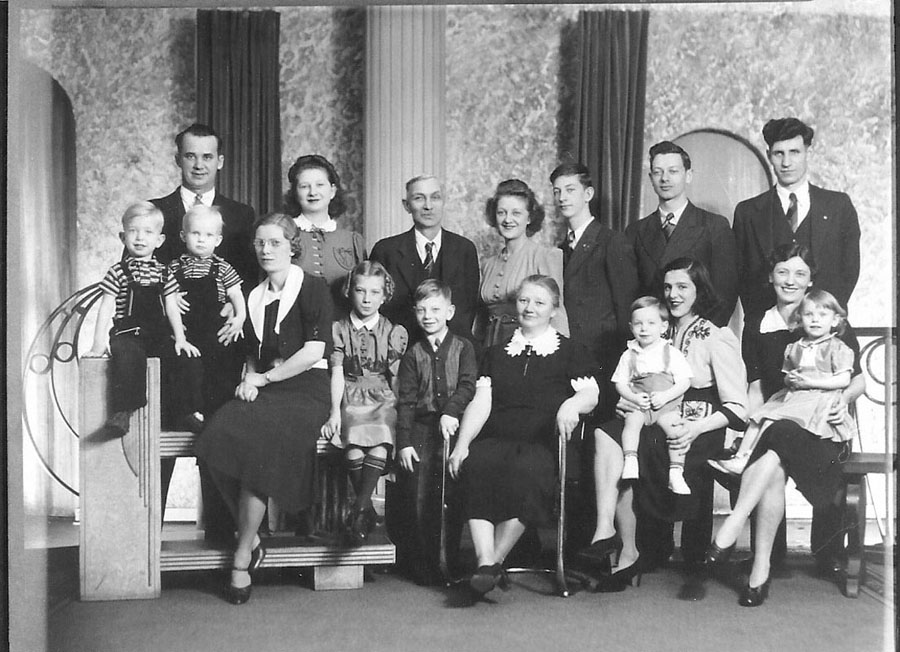
The Extended Batke Family with Link neighbors

The Extended Batke Family with Link neighbors
Pictured in the photo: (Back row, standing, left to right) Herman Fredrick, Anna Batke, Henry Batke, Sr., Selma Batke, Henry Robert Batke, William Batke and Arthur Engler. (Front row/sitting, left to right) Donald Fredrick, Robert Fredrick, Katherine Batke Fredrick, Ruth Batke, Edwin Batke, Katherine Reck Batke, Jerald Batke, Edna Kwiatkowski Batke, Mary Batke Engler and Elaine Engler. Taken c1940, possibly to celebrate Henry and Katherine’s 30th wedding anniversary, October 22, 1940. Photo courtesy: Don Fredrick.

About Henry Batke and Katherine Reck

Heinrich Batke, the son of Martin Batke (c1848-b1912) and Anna Lock (1848-1939) was born in Chortitza, Russia on September 7, 1877. Also in Russia, Catharina Reck was born on October 14, 1890. Her parents were John Reck and Renata Shirk. Henry and Katherine married in Russia on September 22, 1910. On July 13, 1912, Henry, his wife and seven month old daughter, Katherine, sailed from the Port of Bremen, Germany on the ship Pallanza. They traveled to Quebec City, Canada arriving on July 28, 1912. They immediately left on a special Canadian Pacific Railroad train to Saskatchewan, Canada. The Batkes homesteaded in Lydiard, Moose Jaw, Saskatchewan between 1913 and 1918. On October 3, 1917 Henry Batke became a citizen of Canada. Due to England's sovereignty over Canada, he became a British citizen. Finding farming in Canada difficult, on December 7, 1921 the Batke family, now also including Mary, William and Selma, left for Yellow Pine, Alabama. After the birth of Anna and much hardship in Alabama, the family moved to St. Joseph, Michigan where children Henry, Ruth and Edwin were born. Henry, a furniture maker in Russia, became a machine operator at the 1900 Corporation, a fore-runner of Whirlpool, in St. Joseph. After Henry's death on April 7, 1949, Katherine Reck Batke married Gustav Schmeichel in 1959. Katherine Reck Batke Schmeichel died at the Claremont Nursing Home in Benton, Michigan on October 28, 1979.
Showing posts with label Saskatchewan. Show all posts

Friday, November 12, 2010

The Story of Jacob and Maria Link - Part 4 of 9

THE RUSSIAN REVOLUTION

The Russian Civil War in the Ukraine was from 1914-1923.  With the abdication of Tsar Nicholas II, Russia was thrown into bloody revolution.  The Mennonite communities of the Ukraine were the scene of the most violent uprisings and bandit raids in the history of the Russian Civil War!!!  First the anarchist, (bandits) then the Bolsheviks, lay waste to their land. `By 1918, anarchy had completely destroyed the once thriving Mennonite community.

Farms, homes, personal possessions, even life itself, felt the fist of tyranny!  Plagues of diseases such as Cholera and Typhus, along with starvation took their toll.  Suffering became a way of life!

After the bandits were turned back, the Ukraine found itself under Communist rule.  Many were sustained by their faith, but the government had no use for anyone who believed in God.

It was only a short time before WWI, which started in 1914!  At that time, the hatred of everything German reached new heights.   Grandpa and Grandma’s parents and sister Elizabeth were still there!  We don’t know what might have happened to them during this time period.  Our records show that Friedrich and Elizabeth died in Russia, and that Friedrich lived to be 91 years old, and passed away in 1943 (from Brenda Link).  But there is no record of Great Grandma!   Could she have been one of the casualties??  Much of this was taken from “A family Strives for Survival During the Russian Revolution.”

THEY ARRIVE

The time level that these families arrived in Canada:  the Batkes arrived  July 28, 1912, the arrival time for the Friedrich Link family was well after August of 1912,  possibly into October of  that year,  Jacob and Maria arrived  January 27, 1913, and Peter and the Knack family arrived April 3, 1913.  They still had to travel across Canada  by train to Moose Jaw and  Swift Current.  Surely there was great rejoicing upon each family’s arrival!! 

How did Friedrich and Maria accommodate so many?  They all arrived just before, or well into a Canadian winter!!  My conclusion, (only a conclusion), is that they had help from the Mennonites!   It is known that the Batke family didn’t have a history of Mennonite religion in their background, as they were Lutheran, but they did travel with, and lived among the Mennonites in Canada, and in Russia, which was heavily populated with Mennonite families, as did the Link’s!

As more settlers came to the prairies of Saskatchewan on railways, the population grew.  Saskatchewan became a Province on September 1, 1905.  The Homestead Act permitted settlers to acquire one quarter of a square mile of land.  Immigration peaked in 1910 and in spite of initial difficulties of frontier life, distance from towns, possibly sod homes,   and backbreaking labor, a prosperous (agrarian) society was established.  (An agrarian society is one that is based on agriculture as a prime means of support.)

There were rules concerning the land!  They were required to clear 10 acres of each quarter section per year and put it under cultivation the following year. 

Mr. Henry Batke broke 23 acres of new ground in 1914, cleared 21 acres in 1915 and planted 44 acres.  The house was 16x24 with 250.00 worth of lumber.  The barn was 18x30 and a granary was 12x14. Henry Batke received a Land Patent dated March 30, 1918 indicating official ownership of a quarter section of land equaling 160 acres.

As there were no, or few trees, it can be assumed that they had to buy lumber to build a house, barn and granary, possibly from the Mennonites, who were well established by then.  That is how they know the value of their houses.  Where did they live while building their houses?

Saskatchewan Homestead Map c1915; Blue-Links; Red-Batkes
On March 28, 1913 Friedrich Link applied for Homestead Patent for a quarter section of land at the age of 39.  He states that he has lived on the land continuously from that date with his wife and seven children.  In 1913 he cleared and planted 10 acres.  1914 he cleared 15 and planted 25.  1915 he cleared 5 and planted 30 acres.  And in 1916 he cleared 45 and planted 75 acres!

Saskatchewan Homestead Layout-Click image to enlarge

In a sworn statement by Heinrich Krueger for Jacob Link in reference to the application for land patent, November 22, 1917, he states that Jacob was a farmer since 1913 and that he had lived on the land continuously, with his wife and 3 children since May of 1914.  In 1914 he cleared 15 acres and cropped 8.  In 1915 he cleared 20 acres and cropped 15.  In 1916 he cleared 35 acres and planted 35.  In 1917, he cleared nil, and planted 70 acres. 

In 1914 Grandpa had 4 cattle, in 1915, 5 cattle and 1 hog.  In 1916, he had 2 cattle, 4 horses and 2 hogs, and in 1917, he had l cow, 4 horses and 6 hogs.    He also had a 14x18 frame house valued at 200.00, and 10 acres of fencing worth 35.00, a 14x20 framed barn along with a good well valued at 50.00.  Our mother described this house as having 3 rooms, but they had to be very small rooms, or partitioned off in some other way  than actual walls.         

When clearing the land is mentioned, more than likely this did not mean clearing of big trees, as one might think.  The prairie was known as the “steppe” meaning “without trees”.  Katharine Batke Fredrick remembered that the “steppes” of Canada destroyed plows because of all the rocks.  

Think about it!  When they settled on their homestead, there was nothing there! No shelter, no water, nothing!  They had arrived with only what they could carry, one would assume!  Three of the families had small children!  But they were FREE at last!

Brothers Peter, Jacob and Friedrich Link, Canada, c1913

Wednesday, April 14, 2010

Henry Batke, Certificate of Naturalization, 1917

On October 3, 1917, Henry Batke became a British citizen of the Dominion of Canada. It is very likely Henry had to go to Swift Current to collect his Certificate of Naturalization.

There is a curious line in this document:

"This is therefore to certify to all whom it may concern that, under and by virtue of the said Act Henry Batke has become naturalized as a British subject, and is, within Canada, entitled to all political and other rights, powers and privileges and subject to all obligations to which a natural born British subject is entitled or subject within Canada with this qualification, that he shall not when within the limits of the foreign State of which he was a subject previous to the date hereof, be deemed to be a British subject unless he has ceased to be a subject of that State, in pursuance of the laws thereof, or in pursuance of a treaty or convention to that effect."

So, Henry could, theoretically, still be a Russian subject if he returned Russia!  Also, if I read this correctly, he was only a British subject in the Dominion of Canada, not in the other countries which formed Great Britain.

With Henry's naturalization final, he could now complete his patent for his homestead which he began on March 22, 1913.

Henry Batke, Certificate of Naturalization, File #7313, Family History Library, Salt Lake City, Utah, MF#2294910, (October 3,1917); Swift Current Judicial District, Saskatchewan, Canada.

Posted by Picasa

Henry Batke, Oath of Residence/Allegiance, Canada, 1917

Before anyone could become a citizen of Canada, an Oath of Residence was required. The individual had to swear that "in the period of five years preceding this date, I have resided at least three months in the Dominion of Canada, with the intent to settle therein, without having been during such three months a stated resident in any foreign country, So help me God." Henry Batke swore to this on July 18, 1917. (Note in the following post, the Certificate entitling Henry Batke to Naturalization states that he has been in the country for three years.  This is confusing.)

Additionally, an "Oath of Allegiance" was required. The document reads:
"I, Henry Batke, formerly of Thortz in the Province of Jekaterinslaw, Russia, and known there by the name of Henry Batke and now residing at Lydiard, P.C. in the Province of Saskatchewan, farmer, do sincerely promise and swear that I will be faithful and bear true allegiance to His Majesty King George V., as lawful Sovereign of the United Kingdom of Great Britain and Ireland, and of the Dominion of Canada, dependent on and belonging to said Kingdom, and that I will defend him to the utmost of my power against all traitorous conspiracies or attempts whatsoever which shall be made against His Person, Crown and Dignity, and that I will do my utmost endeavour to disclose and make known to His Majesty, His heirs or successors all treason or traitorous conspiracies and attempts which I shall know to be against Him, or any of them; and all this do swear without equivocation, mental evasion or secret reservation. So help me God."
Henry swore this oath before George Mayson, Justice of the Peace, in Chaplin, Saskatchewan on July 18, 1917.

Henry's signature appears twice on this document. Note that "Chortitza" has variant spellings depending on whether the document is in English, German or Russian. "Choritiza" and "Thortz" are the same place.  Also, "P.C." after Lydiard, stands for "Postal Code." 

The Justice of the Peace then drew up another document entitled: "Certificate that Alien is entitled to Certificate of Naturalization." That document follows in the next post.
Posted by Picasa

Henry Batke, Certificate Entitling Naturalization, 1917

Once the oaths of residence and allegiance were sworn to by the alien, as Henry Batke did in the above post, the Justice of the Peace would make a determination whether the alien had met all of the conditions for citizenship. Having made this determination, he prepared the document you see to the left: "The Naturalization Act: Certificate that Alien is Entitled to Certificate of Naturalization." He would fill out the top portion from information on the previous document. The Justice of the Peace then forwarded this document along with the Oath of Residence and Oath of Allegiance to the Clerk of the District Court, in Henry Batke's case it was to the Judicial District of Swift Current.  On the wrapper of Henry's naturalization papers, it is stamped "Judicial District of Swift Current, July 20, 1917, RECEIVED"

When the Clerk of the District Court received the documents he posted them for at least two weeks in his office/court to see if anyone objected to the alien being naturalized.  If no objections were received, as it appears in Henry Batke's case, the Clerk signed the document.  This document then became the basis for Henry's Certificate of Naturalization which is shown in the following post.   Note the court in Swift Current received the papers on July 20, 1917 but didn't complete the process until October 3, 1917.

For a short introduction into the Naturalization Process in Canada, click on Canadian Naturalization Process.
Posted by Picasa

Wednesday, March 24, 2010

Pallanza Manifest, page 15

On page 15 of the Pallanza passenger list it shows Batkes on lines 27 - 29.
Line 27: $580(?) in cash, Batke, Johan, age 35
Line 28: Batke, Anna, age 65
Line 29: Batke, Anna, age 11
The Batkes state they can read and write; their country of birth is Russia and their race is German. Their destination is Ernfold, Saskatchewan. Johan states he was a farmer in Russia and plans to be a farmer in Canada. They say they plan to "always" stay in Canada and declare their religion as Evangelical.  They note they will be traveling inland on the Canadian Pacific Railway (CPR).
Posted by Picasa

Tuesday, March 23, 2010

Pallanza Manifest, page 16

Posted by Picasa 
Listed on page 16 of the Pallanza manifest for July 13-28, 1912 are several more of the Batke family.
Line 1: $160 in cash; Batke, Heinrich, age 34
Line 2: Batke, Catarina, age 22
Line 3: Batke, Catarina, age 2/12
Line 4: $50 in cash; Batke, Karl, age 29
Line 5: Batke, Frederika, age 24
Line 6: Batke, Anna, age 2
The information for these Batkes is the same as for those on page 15.  The adults state they can read and write and plan to stay in Canada permanently.  They declare their country of birth as Russia, race as German and their destination as Ernfold, Saskatchewan.  The male adults say they were farmers in Russia and that they plan to be farmers in Canada.  They also state their religious denomination as Evangelical.  And, they plan to travel, once they land, on the Canadian Pacific Railway (CPR).

Wednesday, March 17, 2010

Batke/Link Homesteads, Saskatchewan

The Saskatchewan Homestead Index is a file locator database to the homestead files at the Saskatchewan Archives. It contains 360,000 references to those men and women who, from 1872 to 1930, under the terms of the Dominion Lands Act, took part in the homestead process in the area now known as Saskatchewan.
On its website Saskatchewan Homestead Index, the Batke and Link homesteads are listed.

From information on this website, I have drawn out Kelstern, Township 14 of Range 6, 3W and noted who originally homesteaded in this Township. I have also added the section of Township 13, where Jacob Link had his homestead, so one could see how close they all lived together.   A full Township, e.g., Township 14, consists of 36 sections and is approximately six miles square in size.

The Homestead file number, homesteader's name and the land survey description for each of the yellow squares are as follows:

- #2887368, Mrs. Anna Batke, Part SW, Section 23, Township 14, Range 6, Meridian W3
- #0784874, Henry Batke, Part SE, Section 22, Township 14, Range 6, Meridian W3
- #2834533, Johan Batke, Part NW, Section 23, Township 14, Range 6, Meridian W3
- #2603054, Karl Batke, Part NW, Section 1, Township 14, Range 6, Meridian W3
- #2451684, Friedrich Link, Part NW, Section 7, Township 14, Range 6, Meridian W3
- #2025984, Jacob Link, Part NE, Section 34, Township 13, Range 6, Meridian W3
Posted by Picasa