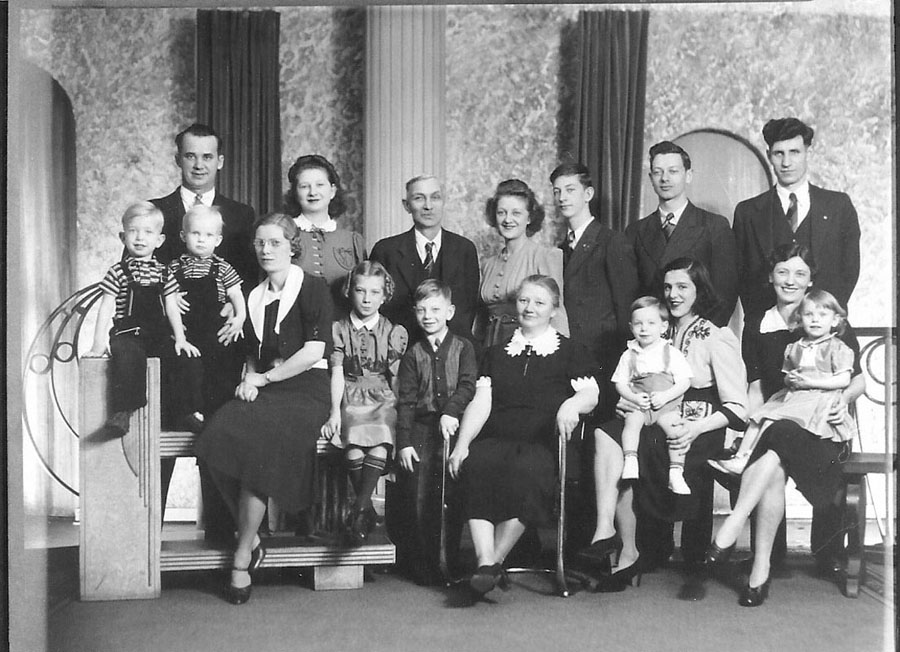
The Extended Batke Family with Link neighbors

The Extended Batke Family with Link neighbors
Pictured in the photo: (Back row, standing, left to right) Herman Fredrick, Anna Batke, Henry Batke, Sr., Selma Batke, Henry Robert Batke, William Batke and Arthur Engler. (Front row/sitting, left to right) Donald Fredrick, Robert Fredrick, Katherine Batke Fredrick, Ruth Batke, Edwin Batke, Katherine Reck Batke, Jerald Batke, Edna Kwiatkowski Batke, Mary Batke Engler and Elaine Engler. Taken c1940, possibly to celebrate Henry and Katherine’s 30th wedding anniversary, October 22, 1940. Photo courtesy: Don Fredrick.

About Henry Batke and Katherine Reck

Heinrich Batke, the son of Martin Batke (c1848-b1912) and Anna Lock (1848-1939) was born in Chortitza, Russia on September 7, 1877. Also in Russia, Catharina Reck was born on October 14, 1890. Her parents were John Reck and Renata Shirk. Henry and Katherine married in Russia on September 22, 1910. On July 13, 1912, Henry, his wife and seven month old daughter, Katherine, sailed from the Port of Bremen, Germany on the ship Pallanza. They traveled to Quebec City, Canada arriving on July 28, 1912. They immediately left on a special Canadian Pacific Railroad train to Saskatchewan, Canada. The Batkes homesteaded in Lydiard, Moose Jaw, Saskatchewan between 1913 and 1918. On October 3, 1917 Henry Batke became a citizen of Canada. Due to England's sovereignty over Canada, he became a British citizen. Finding farming in Canada difficult, on December 7, 1921 the Batke family, now also including Mary, William and Selma, left for Yellow Pine, Alabama. After the birth of Anna and much hardship in Alabama, the family moved to St. Joseph, Michigan where children Henry, Ruth and Edwin were born. Henry, a furniture maker in Russia, became a machine operator at the 1900 Corporation, a fore-runner of Whirlpool, in St. Joseph. After Henry's death on April 7, 1949, Katherine Reck Batke married Gustav Schmeichel in 1959. Katherine Reck Batke Schmeichel died at the Claremont Nursing Home in Benton, Michigan on October 28, 1979.
Showing posts with label Communism. Show all posts

Friday, November 12, 2010

The Story of Jacob and Maria Link - Part 4 of 9

THE RUSSIAN REVOLUTION

The Russian Civil War in the Ukraine was from 1914-1923.  With the abdication of Tsar Nicholas II, Russia was thrown into bloody revolution.  The Mennonite communities of the Ukraine were the scene of the most violent uprisings and bandit raids in the history of the Russian Civil War!!!  First the anarchist, (bandits) then the Bolsheviks, lay waste to their land. `By 1918, anarchy had completely destroyed the once thriving Mennonite community.

Farms, homes, personal possessions, even life itself, felt the fist of tyranny!  Plagues of diseases such as Cholera and Typhus, along with starvation took their toll.  Suffering became a way of life!

After the bandits were turned back, the Ukraine found itself under Communist rule.  Many were sustained by their faith, but the government had no use for anyone who believed in God.

It was only a short time before WWI, which started in 1914!  At that time, the hatred of everything German reached new heights.   Grandpa and Grandma’s parents and sister Elizabeth were still there!  We don’t know what might have happened to them during this time period.  Our records show that Friedrich and Elizabeth died in Russia, and that Friedrich lived to be 91 years old, and passed away in 1943 (from Brenda Link).  But there is no record of Great Grandma!   Could she have been one of the casualties??  Much of this was taken from “A family Strives for Survival During the Russian Revolution.”

THEY ARRIVE

The time level that these families arrived in Canada:  the Batkes arrived  July 28, 1912, the arrival time for the Friedrich Link family was well after August of 1912,  possibly into October of  that year,  Jacob and Maria arrived  January 27, 1913, and Peter and the Knack family arrived April 3, 1913.  They still had to travel across Canada  by train to Moose Jaw and  Swift Current.  Surely there was great rejoicing upon each family’s arrival!! 

How did Friedrich and Maria accommodate so many?  They all arrived just before, or well into a Canadian winter!!  My conclusion, (only a conclusion), is that they had help from the Mennonites!   It is known that the Batke family didn’t have a history of Mennonite religion in their background, as they were Lutheran, but they did travel with, and lived among the Mennonites in Canada, and in Russia, which was heavily populated with Mennonite families, as did the Link’s!

As more settlers came to the prairies of Saskatchewan on railways, the population grew.  Saskatchewan became a Province on September 1, 1905.  The Homestead Act permitted settlers to acquire one quarter of a square mile of land.  Immigration peaked in 1910 and in spite of initial difficulties of frontier life, distance from towns, possibly sod homes,   and backbreaking labor, a prosperous (agrarian) society was established.  (An agrarian society is one that is based on agriculture as a prime means of support.)

There were rules concerning the land!  They were required to clear 10 acres of each quarter section per year and put it under cultivation the following year. 

Mr. Henry Batke broke 23 acres of new ground in 1914, cleared 21 acres in 1915 and planted 44 acres.  The house was 16x24 with 250.00 worth of lumber.  The barn was 18x30 and a granary was 12x14. Henry Batke received a Land Patent dated March 30, 1918 indicating official ownership of a quarter section of land equaling 160 acres.

As there were no, or few trees, it can be assumed that they had to buy lumber to build a house, barn and granary, possibly from the Mennonites, who were well established by then.  That is how they know the value of their houses.  Where did they live while building their houses?

Saskatchewan Homestead Map c1915; Blue-Links; Red-Batkes
On March 28, 1913 Friedrich Link applied for Homestead Patent for a quarter section of land at the age of 39.  He states that he has lived on the land continuously from that date with his wife and seven children.  In 1913 he cleared and planted 10 acres.  1914 he cleared 15 and planted 25.  1915 he cleared 5 and planted 30 acres.  And in 1916 he cleared 45 and planted 75 acres!

Saskatchewan Homestead Layout-Click image to enlarge

In a sworn statement by Heinrich Krueger for Jacob Link in reference to the application for land patent, November 22, 1917, he states that Jacob was a farmer since 1913 and that he had lived on the land continuously, with his wife and 3 children since May of 1914.  In 1914 he cleared 15 acres and cropped 8.  In 1915 he cleared 20 acres and cropped 15.  In 1916 he cleared 35 acres and planted 35.  In 1917, he cleared nil, and planted 70 acres. 

In 1914 Grandpa had 4 cattle, in 1915, 5 cattle and 1 hog.  In 1916, he had 2 cattle, 4 horses and 2 hogs, and in 1917, he had l cow, 4 horses and 6 hogs.    He also had a 14x18 frame house valued at 200.00, and 10 acres of fencing worth 35.00, a 14x20 framed barn along with a good well valued at 50.00.  Our mother described this house as having 3 rooms, but they had to be very small rooms, or partitioned off in some other way  than actual walls.         

When clearing the land is mentioned, more than likely this did not mean clearing of big trees, as one might think.  The prairie was known as the “steppe” meaning “without trees”.  Katharine Batke Fredrick remembered that the “steppes” of Canada destroyed plows because of all the rocks.  

Think about it!  When they settled on their homestead, there was nothing there! No shelter, no water, nothing!  They had arrived with only what they could carry, one would assume!  Three of the families had small children!  But they were FREE at last!

Brothers Peter, Jacob and Friedrich Link, Canada, c1913

Tuesday, September 14, 2010

Gojeck Faces Contempt Charge, March 2, 1955 Front Page Article

In an earlier posting on this Blog, a letter from Henry Batke, dated March 5, 1955, to the Editor of The Herald-Press, appeared.  At the time of the previous posting, the article referred to in the letter to the editor could not be located.  It has now been found and appears below.  Although Henry Batke, Jr., is not mentioned in the front page article, the accompanying photo, by placement next to the article, implies those pictured might have some relationship to the Communist Party.  Again, remember this is the time of McCarthyism.


The text under the photo reads:
TARGET OF ATTACK-- Man identified by IUE publicity agent, Ray Hansen, as Alec Leith, a one-time writer for the Communist newspaper, The Daily Worker, is shown above standing at right on the steps of UE local 931 office in St. Joseph.  Hansen charged over WHFB last night that Leith was formerly known as Alex Goldmann and that he wrote a "greeting" in the booklet entitled: "Two Decades of the Communist Party in New York State."  Leith, said Hansen, is handling UE publicity during the local struggle to retain bargaining rights at Whirlpool.  Standing on steps with Leith is Robert Mounsey, route 2, Eau Claire, one of the UE's most ardent local supporters.  Man with back to camera is identified as Henry Batke, who took a trip to Soviet Russia three years ago.

If you wish to enlarge photo, double click on image. To read Henry Batke's March 5, 1955 response to the photo and the following article, click on letter-to-the-editor.

The following article adjoined the photo on page one of The Herald-Press, March 2, 1955.

GOJECK FACES CONTEMPT CHARGE

ACTION LOOMS
AS WHIRLPOOL
BALLOTS ON UE
Probers Hold UE Leader's
Quiz Stand In Contempt
Of Congress

A contempt of congress citation for United Electrical' workers official John T. Gojack seemed virtually certain today in the wake of a house un-American activities subcommittee vote to cite him, the Associated Press reported from Washington D. C.

The impending citation against Gojack comes on the day when Local 931 of the UE, St. Joseph, puts its fate on the line in an NLRB election to determine a bargaining agent for the Whirlpool corporation's 2,400 production and maintenance workers. Chairman Walter (D-Pa) of the full committee said the group would approve the unanimous recommendation against Gojack. The house, which has the final vote on committee contempt citations, has always followed such recommendations in recent years.

Vote To Cite Gojack
The three-man subcommittee, headed by Rep. Moulder (D-Mo), voted to cite Gojack in open session late Tuesday at the climax of a two day tussle with the 38-year-old UE vice president. Gojack, who is president of the UE's District 9, hotly declared, "It is time that more people in the country challenge this committee."  Gojack had wriggled, evaded questions and defied the committee throughout his two days in the witness chair. His testimony followed that of Miss Julia Jacobs, 34-year old secretary of Local 931 in St. Joseph.  Throughout his testimony, Gojack invoked the first amendment guaranteeing freedom of speech—in refusing to answer the Red-hunter questions.

Refuse 21 Times
Monday afternoon, Gojack refused 21 times to deny that he was, or is a member of the Communist party, in the face of a series of direct questions from subcommittee members and Counsel Frank Tavenner.  Committee sources emphasized what they considered an important difference between Gojack's refusal to answer questions on his alleged Communist connections and the position taken by Miss Jacobs, who declined to answer 122 questions on Monday, pleading the fifth amendment, which protects witnesses from having to give testimony that might be harmful to themselves. Gojack's lawyer, Frank Donner of New York, said the contempt citation against Gojack would provide a clear cut court test of the use of the first amendment as ground for refusing to answer questions of congressional probers.

UE's national secretary-treasurer, Julius Emspak, used the first amendment before a congressional committee on Dec. 5, 1949. He subsequently was cited for contempt and a District of Columbia court sentenced him to serve six months and to pay a $500 fine after he was convicted of the charge on Feb. 26, 1951.

Emspak's conviction was upheld by the United States court of appeals for the District of Columbia on Dec. 19, 1952. Emspak's final appeal is now pending before the Supreme court. Gojack was active in St. Joseph in 1953 when the UE was challenged by the IUE and IAM, but retained its bargaining right in two NLRB elections at Whirlpool. IUE and IAM again are the challenging unions in today's vote at the St. Joseph corporation, the world's largest manufacturer of home laundry appliances and the UE's largest remaining stronghold.

Monday, August 9, 2010

Henry Batke Jr., Letter to the Editor, 1955

Trip to Russia

Editor
The News-Palladium:

Smear by innuendo is a fair description of the reference in The News-Palladium of March 2 to my trip to Russia some three years ago. The inference is that because I visited in the Soviet Union for approximately three weeks, 2,500 Whirlpool workers should dump this (UE) union.  I visited Russia, as my friends know, because I was curious about the country the whole world is wondering about.  I hope to visit China and Germany someday and I trust that this will not be interpreted as an endorsement of Chinese or German policies.

In short, I hope to continue to travel where I please and vote as I please as guaranteed by the Constitution of the United States.

I am deeply disturbed as are others that the newspapers should use my trip to another country to smear a union.  This union has been part of our community for the past 14 years and has contributed greatly to the well being and prosperity of the twin cities and surrounding communities.

HENRY BATKE, JR.
714 Vine street,
St. Joseph, Mich.

This letter to the editor appeared in The News-Palladium, Benton Harbor, Mich., Saturday, March 5, 1955, page 2.  Unfortunately, I am unable to locate the March 2 article referred to in the above Letter to the Editor.

This was the period of McCarthyism.  The following short summary from Wikipedia outlines the issues of the time:

McCarthyism is the political action of making accusations of disloyalty, subversion, or treason without proper regard for evidence. The term specifically describes activities associated with the period in the United States known as the Second Red Scare, lasting roughly from the late 1940s to the late 1950s and characterized by heightened fears of communist influence on American institutions and espionage by Soviet agents. Originally coined to criticize the anti-communist pursuits of U.S. Senator Joseph McCarthy, "McCarthyism" soon took on a broader meaning, describing the excesses of similar efforts. The term is also now used more generally to describe reckless, unsubstantiated accusations, as well as demagogic attacks on the character or patriotism of political adversaries.

During the post–World War II era of McCarthyism, many thousands of Americans were accused of being Communists or communist sympathizers and became the subject of aggressive investigations and questioning before government or private-industry panels, committees and agencies. The primary targets of such suspicions were government employees, those in the entertainment industry, educators and union activists. Suspicions were often given credence despite inconclusive or questionable evidence, and the level of threat posed by a person's real or supposed leftist associations or beliefs was often greatly exaggerated. Many people suffered loss of employment, destruction of their careers, and even imprisonment.


Some Background from Henry Batke Jr.'s nephew, Don Fredrick
A Response to the Posting of the above Newspaper Article
August 11, 2010

"This is interesting.  Now that you have found the article and are sharing it on your blog, Here is a little background.   Maybe I should entitle my comments below, did McCarthyism come to St Joe in Uncle Henry Batke’s case?

"I remember something of the events behind the letter. While in family gatherings before and after his visit to Russia, Henry Batke Jr was known by the family Batke clan to hold forth on his views on the US government, Russia, religion, and unions.   I was a high school student at the time of all of this in a conservative - ultraconservative St. Joseph where I simply was too naive to register real understanding of all that was going on that was coming from him.  Today we can all say as the result of genealogical studies, I’m speculating, that as Germans from Russia we can understand his and our own interest in Russia.  Perhaps he visited family members in his visit to or from Russia. Aunt Anna Batke Pesko might know.

It's important to know that behind the letter he wrote, uncle Henry was a bombardier on a B-17 over Germany who brought to the whole Batke family clan a pictorial history book of WWII after he returned from his tour of duty--and more.

(By the way, it was last Sunday 8/8/10 when 7 B-17's of the 8000+ manufactured at the local Bomber manufacturing plant at Willow Run Airport flew over the Ypsilanti Willow Run airfield at an airshow that spurred memories of Henry.  I saw them and remembered the Henry Batke experience. Thanks to son Mark who invited me to view that airshow.

The Pictorial WWII History from Henry Batke Jr contained vivid pictures of bombing runs by the US Air Force which Henry explained in detail to family members.  In his favor, I admired his military service, was mesmerized by his description of bomber attacks over Germany as described especially to family members and was mystified by what became his singular views about the soviet union during the cold war (1947-1991 according to Wikipedia).  He was a reader, a thinker, and found little sympathy within the immediate and extended family for some of his views based on war duty during WWII and his Russia trip in the '50's.  Before I left to go away to junior college, I remember being able to ask him with others of the family some details of his thinking which he was always willing to share. He anticipated the 1960's in the mid 1950's by his views, one could say, because he saw the horrors of war from 30,000 feet from the bombsight which was his tool for directing pilots at pre-bomb release time and apparent reaction to the war and the tragedies common in the headlines.

Because my father Herman worked for 43 years in a union environment at 1900 Corporation and Whirlpool, I understood the need for unions as well as heard of both management and union problems.  In my corporate consulting and teaching life and because I was a student of W Edwards Deming, I have been ready to discuss both sides of the union and anti-union issue.  It was W Edwards Deming who implored American industry managers and union workers to work together.  Deming insisted that "the system" errors were 70% the fault of management, not because management had to work with unions, but because they failed to make the system work well for both sides.  Needless to say, unions and management relationships are no less controversial today.

The letter below reflects Uncle Henry Batke’s unfulfilled dream of going to both China and Germany.  Unlike uncle Henry, I was not only able to go to the Taiwan version of China but actually serve the Lutheran Church in Taiwan for nearly 5 years there to both learn and teach.  I was also actually able to visit Hong Kong with my wife Barbara, a stone's throw from China.  Last year Barbara and I visited Germany, if only at an airport on the way to Rome.

Unfortunately, Henry mentioned little of what he experienced in Russia that I concretely remember today.  I would recommend that parents urge children of this generation to experience both Russia and China and study these languages as part of the future despite what people may think and because of the benefits of studying first hand other people and their cultures.  I will always value Uncle Henry's experience and point of view as controversial in a city like St. Joseph in the post WW II and cold war periods of our country's history.

It is hoped that someone will find the Mar 2 1955 article in the News Palladium and share it."

Don Fredrick
PS. Thanks Elaine for placing Henry's letter on your blog.


A Response from Roger K. Smith to Comments made by Don Fredrick via Email
August 12, 2010

Don, you are right on, regarding your comments about Uncle Henry.  I do agree 100% with you regarding the facts about Henry, and his timing for traveling to Russia.  He and I have had numerous discussions about that trip, later in life, and the Palladium Article.  My Father too was very involved with Henry regarding the "attitudes" in the area over the trip.

I do remember the War Time albums that  "Hank" had....very nicely cared for and preserved....all of his Military Years......interesting to have him talk about his involvement.